Introducing Wi-Fi 7: The Next Wi-Fi Revolution?
Networking
Wi-Fi has come a long way since the first 802.11 standard (802.11-1997) was created in, yes you guessed it, 1997. Although now we already enjoy the benefits of high speeds and excellent stability with Wi-Fi 6 & 6E, there’s still so much scope for improvement. This improvement comes to us in the form of Wi-Fi 7 or the 802.11be standard.
But before we explore Wi-Fi 7, let’s see how modern wireless standards are doing, shall we?
Wi-Fi 6 & Wi-Fi 6E: Modern Wireless Standards for High-Demand Applications
Wi-Fi 6: Dual Band, OFDMA, and More
The Wi-Fi 6 standard (802.11ax) brought a host of improvements to the table compared to its predecessor, Wi-Fi 5.
It supports higher data rates than previous versions of Wi-Fi, with a maximum data rate of 9.6 Gbps (compared to 3.5 Gbps for Wi-Fi 5). This is achieved using a combination of wider channels (up to 160 MHz), higher order modulation schemes (up to 1024-QAM), and innovative features exclusive to Wi-Fi 6. Here are a few of those features:
Orthogonal Frequency Division Multiple Access (OFDMA)
A new modulation technique called Orthogonal Frequency Division Multiple Access (OFDMA) enables even higher data rates and more efficient use of the available spectrum. OFDMA allows multiple devices to transmit data on the same channel, which enhances the overall throughput of the network.
While OFDMA does allow for faster data rates, it also contributes to the stability of connections to a wireless network. Multiple devices being able to transmit data simultaneously reduces the contention in a network – improving overall stability of your connections.
Base Service Station (BSS) Color
Another Wi-Fi 6 feature that helps with higher data rates is Base Service Station (BSS) Color. Older Wi-Fi generations rely on a ‘listen-before-speaking' approach to wireless connections. So, any noise on a wireless channel (even from another network) meant a long wait until the channel was clear. Now, BSS Color allows Wi-Fi 6 access points to ‘color’ their transmissions, which allows devices to differentiate between transmissions in their own network vs. those belonging to neighboring ones.
Another feature called Transmit Beamforming enables your access point (router) to intelligently focus the transmission of data towards specific devices that need it. Not only does this significantly improve the signal-to-noise ratio, but it also enhances range, and consequently, stability.
Target Wake Time (TWT)
Devices have traditionally transmitted data whenever they have something to send. Not only does this lead to frequent wake-ups and spectrum use, but it also increases power consumption.
A new feature called Target Wake Time (TWT) allows devices to coordinate their communication more efficiently – resulting in lower power consumption and longer battery life for devices connected to the network. It’s particularly useful for devices that remain connected to a network and need to periodically transmit data (like IoT or smart home devices).
Wi-Fi Protected Access 3 (WPA 3)
Wi-Fi 6 also boasts the next generation of wireless security with WPA3, finally improving on WPA2 that we’ve used for quite a long time now. One of the most significant improvements here was the implementation of the Dragonfly Key Exchange System (or Simultaneous Authentication of Equals) - making passwords harder to crack thanks to a more sophisticated handshake mechanism.
Wi-Fi 6E: 6GHz Enters the Chat*
While Wi-Fi 6 was a monumental upgrade in terms of features, speeds, and functionality, it still relies on the 2.4 and 5GHz spectrums, which are already chock full of wireless traffic. To leverage the maximum speeds enabled by Wi-Fi 6, access to a less-crowded frequency band would be ideal.
That’s where Wi-Fi 6E enters the picture. It allows devices to also use the 6GHz frequency band (1200MHz bandwidth) to quickly deliver massive amounts of data over short distances. By moving heavy traffic away from the popular 2.4 and 5GHz bands, you can help alleviate congestion and interference even for older devices!
*Regional Laws
Although 41 countries, representing 54% of world GDP, have now authorized 6GHz for use, many countries are still uncertain.
The cause for uncertainty can range from the spectrum being used for other types of communications to just bureaucratic red tape. As of now, here is a map of the countries adopting or considering the use of this spectrum for Wi-Fi:

Image Source - Wi-Fi Alliance
Wi-Fi 7 (802.11be): Enable Next-Gen Wireless Connectivity
While Wi-Fi 6 offered nearly 50% faster data rates, it still wasn’t a generational leap in actual speed. On the other hand, Wi-Fi 7 is a massive leap forward. The IEEE 802.11be (Wi-Fi 7) standard takes Wi-Fi 6’s theoretical maximum of 9.6Gbps to a whopping 46 Gbps!
So, what exactly does this new standard bring to the table? Here are 4 key improvements you can expect to see –
- Quadruple the Throughput: With a data rate of up to 46Gbps (4.8 times Wi-Fi 6), Wi-Fi 7 is set to be the wireless standard of the future.
- 100x Better Worst-Case Latencies: You can expect a whopping 100x improvement to worst-case Wi-Fi 6 latencies when using Wi-Fi 7. What’s more, it also improves latency by up to 15x when using AR/VR applications.
- Expanded Capacity: Thanks to a combination of 320 MHz channels and Multi-Link Operation (MLO), Wi-Fi 7 boasts 5 times the network capacity of Wi-Fi 6.
- Better Stability: Thanks to a host of features that allow devices to communicate over several bands and channels, wireless networking on Wi-Fi 7 is
Several features go into bringing these improvements to you. Let’s find out more about what makes Wi-Fi 7 great, shall we?
Up to 320MHz Wide Channels
Previous Wi-Fi generations have had to make do with 160MHz channel widths. Wi-Fi 7 brings this width up to 320MHz (only on 6GHz) – ensuring better reliability during simultaneous transmissions at max speeds. Think of it like lanes on a highway/expressway.
Higher Order Modulation with 4K QAM
The Wi-Fi 6 standard relied on 1024-QAM (Quadrature Amplitude Modulation). The higher this QAM value, the more data each packet can carry. Now, Wi-Fi 7 improves the modulation scheme to 4096-QAM – boosting peak transmission rates and network capacity.

Multiple Resource Units (Multi-RU)
Older Wi-Fi generations can send or receive frames only on assigned single Resource Units (RU). However, this limits the flexibility of spectrum resource allocation. With Wi-Fi 7, each device can be allocated multiple RUs – significantly enhancing spectrum utilization.
Preamble Puncturing
Although Preamble Puncturing was an optional feature in Wi-Fi 6, it really comes to the forefront and is a requirement to meet the Wi-Fi 7 standard. In short, this feature allows wireless devices to carve out a slice of ‘busy’ channels when available.
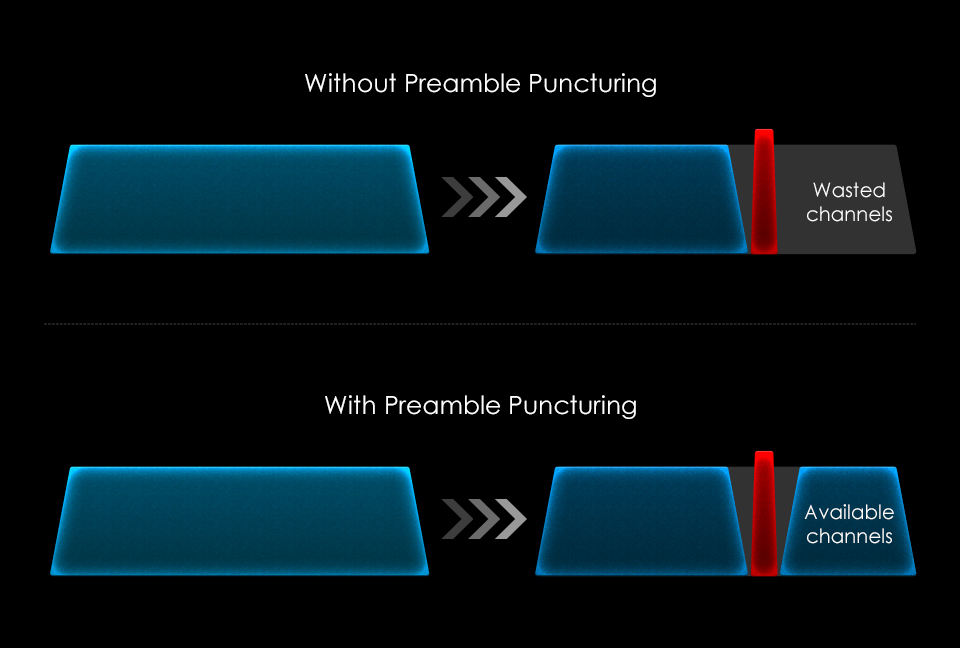
Suppose a device is continuously communicating over a 160MHz channel but using only 20MHz. On previous Wi-Fi generations, this would prevent access points from using this particular spectrum. Preamble puncturing will allow an access point to carve out the remaining bandwidth from that channel for use without any interference.
Multi-Link Operation (MLO)
While legacy Wi-Fi (even Wi-Fi 5/6) enables dual and tri-band operation, devices are forced to pick a specific band to use. For example, you can only select between 2.4GHz and 5GHz variants of your Wi-Fi network. However, this leaves one band ‘wasted,’ in effect.
Wi-Fi 7 resolves this by leveraging a new feature called MLO – allowing Wi-Fi 7 devices to simultaneously send and receive data across several frequency bands and channels.

WiFi 7 vs. WiFi 6/6E vs. WiFi 5
WiFi 5
WiFi 6
WiFi 6E
WiFi 7
Launch date
2013
2019
2021
2024
IEEE standard
802.11ac
802.11ax
802.11ax
802.11be
Max data rate
3.5 Gbps
9.6 Gbps
9.6 Gbps
46 Gbps
Bands
5 GHz
2.4 GHz, 5 GHz
2.4 GHz, 5 GHz, 6 GHz
2.4 GHz, 5 GHz, 6 GHz
Channel size
Up to 160 MHz
Up to 160 MHz
Up to 160 MHz
Up to 320 MHz
Modulation
256-QAM OFDM
1024-QAM OFDMA
1024-QAM OFDMA
4096-QAM OFDMA
MIMO
4×4 MIMO DL MIMO
8×8 UL/DL MU-MIMO
8×8 UL/DL MU-MIMO
16×16 UL/DL MU-MIMOO
Upgrade to Wi-Fi 7 with MSI!
With the growing demands of high-bitrate streaming and online gaming, Wi-Fi 7 is bound to become more of a requirement moving forward – especially for those chasing high-performance wireless networking.
MSI is proud to unveil a brand-new lineup of Wi-Fi 6, 6E, and Wi-Fi 7 gaming routers at CES 2023 – the MSI RadiX Gaming Router lineup. The crowning jewel of the series is the magnificent MSI RadiX BE22000 Wi-Fi 7 Gaming Router.
You can find more details about the RadiX lineup in our CES 2023 coverage!